Friday, August 23, 2013

Give Yourself a #makerbreak


Today we prepared for our new library program, Maker Break. We introduced it in the back to school student weekly calendar, and put up signs physically and then virtually in our @bwslibrary twitter stream.
I also posted the following description on the Library page of the school's website:

Give Yourself a Maker Break
Libraries foster finding information and creating something new from that information. If we extend our thinking of libraries from housing books to making all types of information easily accessible, we see that we can use videos, works of art, and even tweets for information, evaluate that information, and build upon it. Satisfying intellectual curiosity and creativity doesn't always have to happen in the classroom. Often that spark happens elsewhere.

Introducing Maker Break, a table in the library where you can learn new small skills - in the time of a lunch period or half a free track. Relieve some stress, have fun with others, and create something new. Maybe you will be inspired to take these skills and expand them to something else. Maybe you will just feel good for having spent 20 minutes not thinking of school. Maybe you need an alternative to video games to clear your head. Whatever the reason, come to Maker Break for a little dose of fun, sometimes old-fashioned, sometimes high tech, sometimes crafty, sometimes literary. But always with potential for creativity and learning.

Want to know what is happening with Maker Break? follow @bwslibrary on twitter or bwslibrary on instagram, where we are hoping people will post photos or short videos of their work, #makerbreak.

Week #1 is Origami. We are putting out instructions for making some beginner to intermediate origami, including our school mascot, an eagle. We also have paper to fold, and instructions on how to share their creations with the school community. We are excited to have the kids write poetry some weeks, make stop motion with lego, and do other small, inexpensive, put fun "maker" activities, without the 3-D printer. We are trying to get our kids from just hanging out to messing around...maybe someday to geeking out. I'll keep you posted!

What maker activities are you doing at your library this year? Do you have any new programming? 

Friday, August 2, 2013

Summer Professional Development Part Two: ISLE Retreat

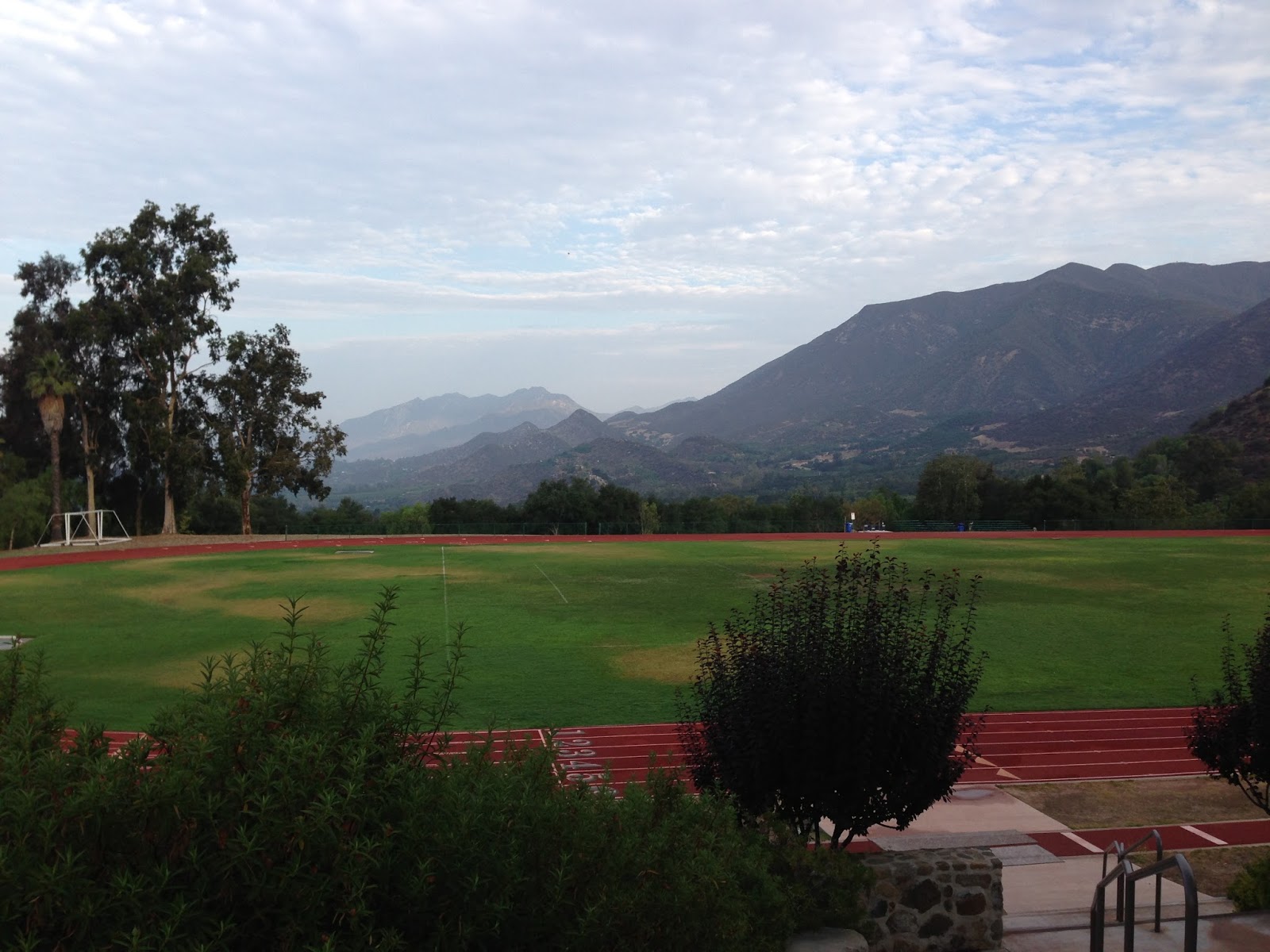
One week after attending NAMLE, I attended another professional development weekend. The Independent School Library Exchange (a Southern California consortium) held a weekend retreat at the gorgeous Thacher School in Ojai.

The librarians at Thacher have wanted to host a retreat for the ISLE group for many years, and finally it happened - and I hope it happens again. The ISLE Board met the first evening, and sat outside with a view of the mountains as we discussed consortium agenda items such as dues, attracting new schools, what to do when a school doesn't pay, the pros and cons of the Ning that we use to communicate and host documents, and we started to discuss what goals we should have for the upcoming year. As a group, we usually meet twice a year, but there usually isn't time for pondering and long discussions, which we finally had time to do.

Saturday morning more librarians came, bringing our total to about 20. Saturday and Sunday we had carefully selected sessions and roundtables on favorite books, professional publishing, LibGuides, book repair, integrating library/information/research skills, and maker spaces. Past Thacher librarian and ISLE member Elizabeth Bowman, now from Santa Barbara City College,  presented about information literacy on the college level, entertaining and informing us, and delivering great ideas.

Our hosts fed us well, and made sure we had time to share more informally during free time. We had time to swim, surprise each other on the high diving board, hike, have dinner in the town, and generally learn from each other and collaborate on new ideas for our schools. I got to know librarians who I had only met at brief meetings in the past, and i am so thankful for the opportunity to do so. Building these relationships will only benefit our school libraries and our work in the future.

I even got to take an early morning run with my fabulous co-worker.
This small and relaxing retreat was extremely beneficial, local, and inexpensive. The complete focus on independent schools was extremely valuable. I hope we can make it a tradition and that more ISLE librarians can take part in it.


Wednesday, July 31, 2013

Summer Professional Development Part One: NAMLE

I had two great new professional development experiences this summer, so in chronological order..

Instead of going to ALA or ISTE this summer, I joined NAMLE, the National Association for Media Literacy Education, and attended their  conference in Torrance, California. I thought it looked interesting, and it was only a 25 minute drive from home, so why not go?
I am glad I tried something new because I learned so much about a diverse group of people who care about media literacy, why they care, and what they are doing about it. NAMLE is a very helpful organization with a ton of quality resources. It was a small conference all in one hotel, and it was packed with interactive sessions, conversations, keynotes, and connections. Attendees were college professors and students of media literacy, producers of systems of teaching media literacy, makers of media in a variety of formats, teachers, researchers, and more.  I was a bit disappointed that I didn't find very many librarians there, because I think we really care quite a lot about media literacy, but I did meet a few (including Rutgers assistant professor Rebecca Reynolds and fabulous high-tech children's librarian Cen Campbell).  Aren't we school librarians often the ones on campus teaching elements of media literacy? Don't you teach (or at least try to get in the curriculum!) about copyright, evaluating information, visual literacy, digital citizenship, and how to be skeptical about information in all formats?
Here is an overview of my conference experience:

Keynote #1:
I have a new Jewish heroine and she is Tiffany Shlain. She spoke about how she makes cloud movies, how to make change through film, how she is helping nonprofits make videos, and she shared her family's unplugged Shabbats, even though this is her medium for her work and creativity! Her site is letitripple.org. Here is her keynote presentation:


Keynote #2:
Jim Berk, CEO of Participant Media, was the other keynote, and he was also inspiring and full of information I can bring back to school.  I am very excited about pivot.tv  in particular. And I love the movies made by Participant Media so I am glad to know more about the company.


The sessions I attended were interesting and worth while as well. Here is a sampling:

I heard about three fabulous girl-led activism organizations involved with media, from Dana Edell, Executive Director of SPARK Movement, Jennifer Berger, Executive Director of About Face
and Dana Hernandez from the  Training Institute for Hardy Girls Healthy Women. These women and their organizations will be great resources for me to inspire the girls I work with and with a new class I am teaching second semester about using social media for social good.

I learned from Chris Sperry about Project LookSharp and how to use constructivist media decoding in classes. This type of conversation with a group of students takes practice, and I hope to start practicing in the fall!

Bonnie Nishihara (technology director) and Joe Harvey (head of school) from Saint Mark's School, an independent school in California, and Cyndy Scheibe (from Project LookSharp)  gave a great overview of how they made media literacy a priority and have integrated it into their K-8 curriculum purposefully and successfully.

Near the closing of the conference, Renee Hobbs led us in an exercise to define what the term media literacy means to all of us. Using brainstorming, collaborating, and hundreds of post it notes, the group came up with lots of ideas. I would love to try to re-create this exercise with school librarians someday.

I think the next NAMLE conference will be in the Spring of 2015 - I hope to see you there! School librarians need to attend this conference to show what we are teaching about media literacy, and to learn what others outside of librarianship are doing. Web/information evaluation, digital citizenship, decoding images, copyright and Creative Commons - it is all a part of it.

Monday, June 24, 2013

Independent School Magazine: The New School Library


So many people, even at our own schools, don't really know what we do. In this article we tried to help non-librarians at Independent schools form more current views of school librarianship and understand how librarianship and school libraries have evolved into the school centers they are today.

Tuesday, June 11, 2013

Pondering E-books, Memory, and Moonwalking

http://www.flickr.com/photos/36263437@N08/5285629858
Found on flickrcc.net

I am fascinated by the recent articles about relating current brain research and reading e-books, like this article from Scientific American by Ferris Jabr, who writes the following:
Beyond treating individual letters as physical objects, the human brain may also perceive a text in its entirety as a kind of physical landscape. When we read, we construct a mental representation of the text in which meaning is anchored to structure. The exact nature of such representations remains unclear, but they are likely similar to the mental maps we create of terrain—such as mountains and trails—and of man-made physical spaces, such as apartments and offices. Both anecdotally and in published studies, people report that when trying to locate a particular piece of written information they often remember where in the text it appeared. We might recall that we passed the red farmhouse near the start of the trail before we started climbing uphill through the forest; in a similar way, we remember that we read about Mr. Darcy rebuffing Elizabeth Bennett on the bottom of the left-hand page in one of the earlier chapters.
In most cases, paper books have more obvious topography than onscreen text. An open paperback presents a reader with two clearly defined domains—the left and right pages—and a total of eight corners with which to orient oneself. A reader can focus on a single page of a paper book without losing sight of the whole text: one can see where the book begins and ends and where one page is in relation to those borders. One can even feel the thickness of the pages read in one hand and pages to be read in the other. Turning the pages of a paper book is like leaving one footprint after another on the trail—there's a rhythm to it and a visible record of how far one has traveled. All these features not only make text in a paper book easily navigable, they also make it easier to form a coherent mental map of the text. 
The article is much longer and points to other areas where e-reading is often less desirable than reading the printed page, but this area stuck me the most.
During Thanksgiving weekend of 2011, I read Moonwalking with Einstein by Joshua Foer. I often marvel at those people with fabulous memories and I wonder how they do it. How do you memorize so many numbers of Pi? How do you memorize cards during card tricks and gambling? One technique that Foer shares from the centuries of memory masters  (he calls contemporary ones mental athletes) is that they visualize a home or a building they know really well and place their memories in locations in the house (or memory palace). Then, they can tour through the house and have this mental map, which gives context to the details they are memorizing. Sometimes instead of a home, mental athletes will image something else, a streetmap they know well, or the human body, "so long as there is some sense of order that links one locus to the next, and so long as they are intimately familiar" (97). One person could have many memory palaces, one for each thing being remembered.

This type of memorization technique must be somehow related to the "mental maps" above that Jabr writes about in Scientific American. Perhaps the physical space of a book naturally helps our brains remember the stories better. Thinking of a book as a structure, or memory palace, and knowing where events happen, and what details occur on what page, probably helps with remembering and context. I wonder if the memory masters Foer writes about prefer e-books or print books for learning.

Wednesday, June 5, 2013

Teaching Citing: The Importance of Individual Attention

This month I spent a lot of time assessing some of what I teach the kids. I haven't done a lot of this in the past, and I am seeing the the fruits of my labor now. Believe me, it has been a lot of new work. But it is so worth it! Here is an overview:

 A teacher asked me to grade some of her works cited sheets from her seniors, and while grading I realized we were failing in how we were trying to teach them how to cite using NoodleTools. Maybe failing is too strong a word.. Some students did well, some didn't, either because they didn't put in the effort, or they didn't know how. They also didn't know I'd be grading it, so senioritis could be part of the problem.

In response, I changed tactics this year with how I teach citing to 9th graders. It is now much more individual in approach. As we embarked on our third project of the year, I did show them briefly how to cite reprinted articles - the last new piece of citing we do as a group. But instead of spending a lot of time on it, I made some quick citing videos: What is a Reprint and How to Cite it, and How to Cite from Bloom's Literary Reference Online. Then, as I did in two other projects this year, I gave them individual feedback online in NoodleTools to their working bibliographies.  I told them if their sites weren't academic, I told them if they didn't understand how to cite the items. I gave them feedback online, and met with several individually either on their free time or in class "workshops" where they could work at their own pace and ask either me or their teacher for help. Then I had them turn in a paper works cited to me and I graded the 120 works cited lists using a rubric which included citing skills from our few years together.

The kids enjoyed this new approach and individualized instruction. Who wants to listen to a lesson about citing or do citations in the abstract? They need to know it when they need it, and I need to be there for them. They have to know when to ask for help - and what to ask. I got to know many of them much better, and I feel like they trust me and know I care about them. They know citing is not exciting, but they also know it is one of my responsibilities to help them understand why and how  to do it. I am excited to see how their skills last as they continue in the upper school. Will their lists of Works Cited be as dismal as the ones I graded from our seniors? Or will this new "worshop" approach work better for them?

I am also in the midst of grading 10th grade blogs. Each 10th grader made blogs during a UN Simulation activity, and I am part of the grading team. I just make sure they are citing quality sources and using proper Creative Commons images on their blogs, with appropriate captions. The tenth graders with more research and Creative Commons experience are doing better than the others, demonstrating that practicing information literacy and digital ethics helps you over time.
 

An interesting side observation:
The most important part of citing is knowing what you are looking at and trying to cite. For the first time this year I had several students think they had the paper copy of a newspaper article for example, because they had printed it out. So they chose print, when actually they were citing a database newspaper article. Interesting.. I long for the day when none of this will matter anymore.


Thursday, April 11, 2013

Library Sleepover!


A recent Friday night was our 11th annual Upper School Library Sleepover. Originally started by students, I was ready to let this tradition retire with the previous librarian, who retired last year and chaperoned and organized this event for a decade. The students who thought of it as a Brentwood School tradition, however, demanded we do it again, and I am so glad we did! As soon as I advertised the event one time at assembly, it was full, with over 20 students wanting to attend. Members of the Student Library Advisory Council (SLAC-ers) decided we would read Arthur Conan Doyle’s A Study in Scarlet and watch the BBC Sherlock version of the Sherlock Holmes novella. One senior created a role-play mystery game for us to solve, which we did at 1:00 AM. She creatively invented characters related to the novella, and gave us each clues on paper made to look old, complete with  wax seals. A tenth grader shared that the “library overnight was a great way to bond and meet new people ... My favorite part was when some people summarized the first half of the book by performing an interpretive dance version. Overall, I had a ton of fun, and I'm definitely excited for next year.” We set up our sleeping bags in front of the TV at around 1:30 AM and most of us were asleep by 3:00. It was a night of laughter, acting, books, mystery, and new friends,  and we are glad to keep the tradition going for another decade.

So many of our kids excel at sports or drama, where they get to have parties - end of season parties or cast parties - with their peers who have similar interests. I was honored to have a party for the students who love to celebrate stories, and I was happy to bring them together. Our foreign exchange student from China came too, and it was so fun for her to enjoy the craziness of the teens being up most of the night. Next year I think we are going to read excerpts from Pride and Prejudice and watch the Lizzie Bennet Diaries - we supported the Kickstarter project and bought the DVD already!