I had two great new professional development experiences this summer, so in chronological order..
Instead of going to ALA or ISTE this summer, I joined NAMLE, the National Association for Media Literacy Education, and attended their conference in Torrance, California. I thought it looked interesting, and it was only a 25 minute drive from home, so why not go?
I am glad I tried something new because I learned so much about a diverse group of people who care about media literacy, why they care, and what they are doing about it. NAMLE is a very helpful organization with a ton of quality resources. It was a small conference all in one hotel, and it was packed with interactive sessions, conversations, keynotes, and connections. Attendees were college professors and students of media literacy, producers of systems of teaching media literacy, makers of media in a variety of formats, teachers, researchers, and more. I was a bit disappointed that I didn't find very many librarians there, because I think we really care quite a lot about media literacy, but I did meet a few (including Rutgers assistant professor Rebecca Reynolds and fabulous high-tech children's librarian Cen Campbell). Aren't we school librarians often the ones on campus teaching elements of media literacy? Don't you teach (or at least try to get in the curriculum!) about copyright, evaluating information, visual literacy, digital citizenship, and how to be skeptical about information in all formats?
Here is an overview of my conference experience:
Keynote #1:
I have a new Jewish heroine and she is Tiffany Shlain. She spoke about how she makes cloud movies, how to make change through film, how she is helping nonprofits make videos, and she shared her family's unplugged Shabbats, even though this is her medium for her work and creativity! Her site is letitripple.org. Here is her keynote presentation:
Keynote #2:
Jim Berk, CEO of Participant Media, was the other keynote, and he was also inspiring and full of information I can bring back to school. I am very excited about pivot.tv in particular. And I love the movies made by Participant Media so I am glad to know more about the company.
The sessions I attended were interesting and worth while as well. Here is a sampling:
I heard about three fabulous girl-led activism organizations involved with media, from Dana Edell, Executive Director of SPARK Movement, Jennifer Berger, Executive Director of About Face
and Dana Hernandez from the Training Institute for Hardy Girls Healthy Women. These women and their organizations will be great resources for me to inspire the girls I work with and with a new class I am teaching second semester about using social media for social good.
I learned from Chris Sperry about Project LookSharp and how to use constructivist media decoding in classes. This type of conversation with a group of students takes practice, and I hope to start practicing in the fall!
Bonnie Nishihara (technology director) and Joe Harvey (head of school) from Saint Mark's School, an independent school in California, and Cyndy Scheibe (from Project LookSharp) gave a great overview of how they made media literacy a priority and have integrated it into their K-8 curriculum purposefully and successfully.
Near the closing of the conference, Renee Hobbs led us in an exercise to define what the term media literacy means to all of us. Using brainstorming, collaborating, and hundreds of post it notes, the group came up with lots of ideas. I would love to try to re-create this exercise with school librarians someday.
I think the next NAMLE conference will be in the Spring of 2015 - I hope to see you there! School librarians need to attend this conference to show what we are teaching about media literacy, and to learn what others outside of librarianship are doing. Web/information evaluation, digital citizenship, decoding images, copyright and Creative Commons - it is all a part of it.
Showing posts with label conferences. Show all posts
Showing posts with label conferences. Show all posts
Wednesday, July 31, 2013


Wednesday, November 30, 2011
Reflections on a Season of Professional Development Part 2
Better Late than Never!
In October I joined over 3,000 librarians attending the American Association of School Librarians conference in Minneapolis. This was a much broader conference, and Steven Carr (the author if The Shallows) and Mimi Ito's ideas were almost pitted against each other. Their keynotes were the beginning and the end of the conference, respectively. I helped just a bit with the Learning Commons, an area where people gave more impromptu talks which were streamed live. For a couple of hours I acted as PR and host for this area, and I got to enjoy some of the presentations as well. I also watched the live streaming of Wendy Stephens' presentation from my hotel room as I rested one afternoon, which was great!
I attended several thought provoking sessions. Realizing that everyone is in the same fuzzy space regarding ebooks, ipads, ereaders, and that we are all grappling with how to interpret copyright issues with regard to multimedia in schools, I am now more comfortable in that muddy space. Now I just am more clear about how we are in the middle of a state of change, and nobody has all the answers. I just have to decide how and when to dive in.
More satisfying were the sessions I chose to attend about teaching research and increasing true inquiry and scholarship.
- I attended 4 hour pre-conference workshop on meaningful senior projects. This session gave me a lot of ideas for new programs at my school.
- I am inspired to use Stripling’s Method of Inquiry to engage learners and provide structure to the messy road of research - help the kids define the chaotic road by using the same method, 7-12. The Big 6 method used by our lower school doesn’t resonate with me, the Stripling method does.I am hoping I can find ways to incorporate it for next year.
- I want to explore the notion of transliteracy - what does that mean for our students and our research curriculum.
- I want to encourage MultiGenre artifacts as objects of creative synthesis of information in order to increase the opportunity for creativity at school.
- I am more knowledgeable of current research on teenagers as Internet searchers, and have ideas on how to incorporate this research into my teaching.
- I enjoyed Informal learning with friends and mentors who are leading the profession, and persuading me to continue my blog and to get involved in professional leadership through ALA, writing for professional publications again, or speaking/presenting at more conferences.
Tuesday, November 15, 2011
Reflections on a Season of Professional Development, Part One
I was lucky to attend two very interesting yet very different professional development experiences this fall. Each had a different focus, and each has helped me think of the library and our curriculum in different ways.
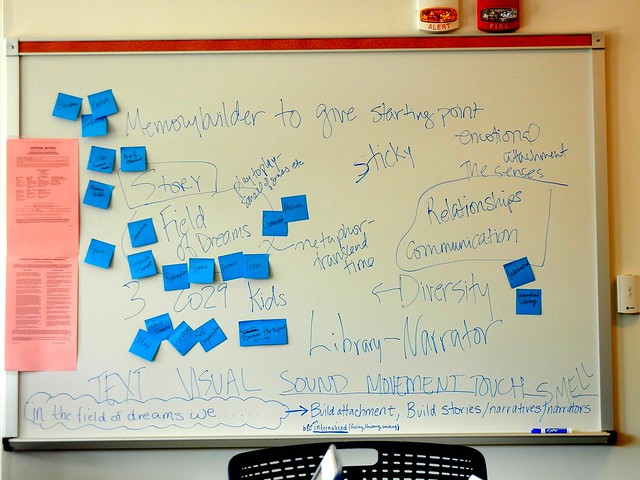
Image: Idea Board, Cohort D by dianecordell
ReImagine: Ed was a gathering of approximately 200 librarians, technology directors, and designers at The Lovett School in Atlanta and was focused on using the design process to imagine the school library of the future.
This conference seemed to be more focused on the physical library as a learning space, and less about the teaching that happens in that space. I learned that we as a profession are well on our way to knowing where we want to go, but the harder next step is how to get there. For some issues, like seamless integration of ebooks, we need to muddle through this time of innovation and uncertainty in the ebook market. But when we think of the library as a space for curiosity and innovation, we need to start now by introducing the ideas to our communities. Like last year, I am focused on Mimi Ito’s work with the MacArthur Foundation and the YOUMedia lab in Chicago as a model we should try to develop for our school.
ReImagine Ed had some very talented leaders and “provocateurs,” and one of my favorites was Lee Van Ordsel, the Dean of University Libraries at Grand Valley State University in Allendale, Michigan. She walked us through her inspiration and vision behind her university’s new main library, which is to be completed by May of 2013. I enjoyed how she spoke about the different uses of space, and her metaphor of the library as a shopping mall was compelling. In a shopping mall, everything is in one social space. “Nobody likes an empty mall,” Ms. Van Ordsel pointed out, so in her library the consumers get to choose what they do, they control the experience, but they also allow for serendipity.
The new library will almost all be for group study, (although there will be some nooks for individual study too) where students can essentially create a room wherever they want to. The space is flexible, blending intellectual and social. They will also provide knowledge market kiosks, no appointments necessary, including a writing center, speech center, I.T. help desk, and research center, all run by student peers.
I enjoyed hearing about this vision and extracting how it might work at my school. My students still need a quiet zone - our many study carrels are very popular, but the other ideas could be redesigned for a small independent school like mine.
After listening to Buffy Hamilton speak powerfully about Enchantment and Bud Hunt talk passionately about the importance of school libraries as a safe space (virtual and physical), I came away with ideas on how to make the library a meaningful place in the lives of our students by being a place where students are safe to be themselves, safe to try and fail, and safe to be creative and make connections. I enjoyed brainstorming library metaphors and learning how libraries can fit into different models.
This conference seemed to be more focused on the physical library as a learning space, and less about the teaching that happens in that space. I learned that we as a profession are well on our way to knowing where we want to go, but the harder next step is how to get there. For some issues, like seamless integration of ebooks, we need to muddle through this time of innovation and uncertainty in the ebook market. But when we think of the library as a space for curiosity and innovation, we need to start now by introducing the ideas to our communities. Like last year, I am focused on Mimi Ito’s work with the MacArthur Foundation and the YOUMedia lab in Chicago as a model we should try to develop for our school.
ReImagine Ed had some very talented leaders and “provocateurs,” and one of my favorites was Lee Van Ordsel, the Dean of University Libraries at Grand Valley State University in Allendale, Michigan. She walked us through her inspiration and vision behind her university’s new main library, which is to be completed by May of 2013. I enjoyed how she spoke about the different uses of space, and her metaphor of the library as a shopping mall was compelling. In a shopping mall, everything is in one social space. “Nobody likes an empty mall,” Ms. Van Ordsel pointed out, so in her library the consumers get to choose what they do, they control the experience, but they also allow for serendipity.
The new library will almost all be for group study, (although there will be some nooks for individual study too) where students can essentially create a room wherever they want to. The space is flexible, blending intellectual and social. They will also provide knowledge market kiosks, no appointments necessary, including a writing center, speech center, I.T. help desk, and research center, all run by student peers.
I enjoyed hearing about this vision and extracting how it might work at my school. My students still need a quiet zone - our many study carrels are very popular, but the other ideas could be redesigned for a small independent school like mine.
After listening to Buffy Hamilton speak powerfully about Enchantment and Bud Hunt talk passionately about the importance of school libraries as a safe space (virtual and physical), I came away with ideas on how to make the library a meaningful place in the lives of our students by being a place where students are safe to be themselves, safe to try and fail, and safe to be creative and make connections. I enjoyed brainstorming library metaphors and learning how libraries can fit into different models.
All in all, ReImagine Ed was a unique, enjoyable, and difficult conference. Grouping professionals with different backgrounds and different ideas of libraries together to work collaboratively had its ups and downs, as did some of the structure of the conference. But it was a good and challenging experience, and I learned a lot about the design process, libraries, librarians, and myself. For more of what my group ended up with, see Diane Cordell's blogpost about Cohort D.
Stay tuned for Part Two: AASL
Stay tuned for Part Two: AASL
Monday, March 7, 2011
Ignited by DML
This week I was lucky to attend the Digital Media and Learning conference in Long Beach, California, only a thirty minute drive from where I live. According to the website,
I was excited to learn about digital learning from a perspective other than the librarian perspective, I was interested to learn about trends we could see in librarianship in the coming years, and I wanted some help with a new part of my school life (next year I am probably gong to co-teach a class with one of our educational technology specialists about using social media for social justice. Several workshops and sessions focused on aspects of this theme, which made me realize we were on the right track by proposing the class.).
Inspired by the workshops, sessions, ignite talks, and exhibits, I took more notes at this conference than most others I have attended. Here are some recurring themes related to school librarianship :
Now that we have our 2.0 skills down, get ready for another change. Many people spoke of the importance of teaching a deeper understanding of the technology in regard to trouble shooting, and understanding that you are in control of your digital experience - if you don't like something you can change it. Our next skill set? Hacking. Remember thinking we didn't really need to know too much html because so many tools do it for you? Well, maybe we do need to know the code.
Look at hackasaurus and find out about their Hack Jams.
People like incentives. Make your social justice campaign or even your portfolio, a game with badges, and people will respond. Yes, badges - online versions of those earned by Boy and Girl Scouts across America. Maybe we should make badges for reading clubs, or badges for new research expertise? Proud you learned how to make a QR code? Now try making a badge - people didn't talk about QR codes at all at the sessions I attended.
Look at the P2PU wiki about their badge program.
Finding time to play and innovate is particularly hard at institutions like schools - but can it be done? How can we make the down time when the students appear to be wasting time on Facebook a more playful and productive time?
Look at YOU Media and think about how we can bring some of this innovation to our libraries.
Participatory media is growing up - but in what ways? How can it be used effectively for civic engagement? What prompts people to participate in online social action? Will games make youth want to use digital media for social justice? Can the games be designed with the values of the community inherent in the design? Why do people get involved in writing entries for Wikipedia? Is that civic engagement?
Look at Nuf Said. Are you inspired?
Next year DML will be in San Francisco. Want to join me?
The Digital Media and Learning Conference is an annual event supported by the MacArthur Foundation and organized by the Digital Media and Learning Research Hub at University of California, Irvine. The conference is meant to be an inclusive, international and annual gathering of scholars and practitioners in the field, focused on fostering interdisciplinary and participatory dialog and linking theory, empirical study, policy, and practice.The smallish conference attracted people interested in sharing current research and innovation connected to online experiences and learning. There were four tracks (Digital Media and Learning, Emerging Platforms and Policies, New Collectives, and Youth, Digital Media and Empowerment), and people floated between tracks quite easily. Browse the almost 100 page conference program to get a sense of the discourse and the amazing presenters.
I was excited to learn about digital learning from a perspective other than the librarian perspective, I was interested to learn about trends we could see in librarianship in the coming years, and I wanted some help with a new part of my school life (next year I am probably gong to co-teach a class with one of our educational technology specialists about using social media for social justice. Several workshops and sessions focused on aspects of this theme, which made me realize we were on the right track by proposing the class.).
Inspired by the workshops, sessions, ignite talks, and exhibits, I took more notes at this conference than most others I have attended. Here are some recurring themes related to school librarianship :
Now that we have our 2.0 skills down, get ready for another change. Many people spoke of the importance of teaching a deeper understanding of the technology in regard to trouble shooting, and understanding that you are in control of your digital experience - if you don't like something you can change it. Our next skill set? Hacking. Remember thinking we didn't really need to know too much html because so many tools do it for you? Well, maybe we do need to know the code.
Look at hackasaurus and find out about their Hack Jams.
People like incentives. Make your social justice campaign or even your portfolio, a game with badges, and people will respond. Yes, badges - online versions of those earned by Boy and Girl Scouts across America. Maybe we should make badges for reading clubs, or badges for new research expertise? Proud you learned how to make a QR code? Now try making a badge - people didn't talk about QR codes at all at the sessions I attended.
Look at the P2PU wiki about their badge program.
Finding time to play and innovate is particularly hard at institutions like schools - but can it be done? How can we make the down time when the students appear to be wasting time on Facebook a more playful and productive time?
Look at YOU Media and think about how we can bring some of this innovation to our libraries.
Participatory media is growing up - but in what ways? How can it be used effectively for civic engagement? What prompts people to participate in online social action? Will games make youth want to use digital media for social justice? Can the games be designed with the values of the community inherent in the design? Why do people get involved in writing entries for Wikipedia? Is that civic engagement?
Look at Nuf Said. Are you inspired?
Next year DML will be in San Francisco. Want to join me?
Sunday, October 10, 2010
Internet@Schools West
I am excited to tell you that Buffy Hamilton, Michelle Simon Fromme, Andrew Shuping, and I will be presenting an interactive workshop called Crowdsourcing Your Library Challenges. Will you be there? I hope so! (Like the video? My husband, Jonathan, did the art, and Animoto did the rest!)
Wednesday, March 10, 2010
Blog Post about Using a Blog to Teach about Blogging. Wait, what?
Monday at the California Association of Independent Schools (CAIS) 2010 Southern Regional Meeting at Campbell Hall School, I presented about blogging using Blogger with Joon Kim, one of the educational technologists and computer science teacher at my school.
After working together for over a decade, Joon and I started experimenting with using tools for expression and collaboration with the students. Along with co-teaching a wiki enhanced research project to our 8th graders, we teach blogging to most of the tenth graders, and we co-sponsor a student life blog. It felt like a natural decision to do a presentation for CAIS together.
The presentation and hands-on session was called Blogging Inside and Outside the Classroom, and we presented from a fairly simple blog. Joon had the great idea of using pre-prepared articles which we posted onto the blog as we started talking about the topics, just to show how it all worked. We traded off speaking, and then co-taught the hands-on part so the approximately 25 attendees could have lots of individual instruction. The students can return to the blog to revisit the lesson.
Although we could have used another half-hour (it was already 90 minutes!), and I started rushing near the end and neglected one small part completely, I think we got people off to a thoughtful and productive start. I enjoyed the way Joon and I collaborated, and I think it made us an even stronger team in the classroom for our students. Presenting about blogging also prompted us to us reflect about our blogs and our teaching, which I suppose is one reason schools like teachers to present at conferences.
All in all, it was a great experience in collaboration, reflection, teaching, and blogging. If you haven't yet tried presenting at a conference, try it out at a local conference to see if you like it. You may surprise yourself at what you learn.
After working together for over a decade, Joon and I started experimenting with using tools for expression and collaboration with the students. Along with co-teaching a wiki enhanced research project to our 8th graders, we teach blogging to most of the tenth graders, and we co-sponsor a student life blog. It felt like a natural decision to do a presentation for CAIS together.
The presentation and hands-on session was called Blogging Inside and Outside the Classroom, and we presented from a fairly simple blog. Joon had the great idea of using pre-prepared articles which we posted onto the blog as we started talking about the topics, just to show how it all worked. We traded off speaking, and then co-taught the hands-on part so the approximately 25 attendees could have lots of individual instruction. The students can return to the blog to revisit the lesson.
Although we could have used another half-hour (it was already 90 minutes!), and I started rushing near the end and neglected one small part completely, I think we got people off to a thoughtful and productive start. I enjoyed the way Joon and I collaborated, and I think it made us an even stronger team in the classroom for our students. Presenting about blogging also prompted us to us reflect about our blogs and our teaching, which I suppose is one reason schools like teachers to present at conferences.
All in all, it was a great experience in collaboration, reflection, teaching, and blogging. If you haven't yet tried presenting at a conference, try it out at a local conference to see if you like it. You may surprise yourself at what you learn.
Subscribe to:
Posts (Atom)