Wednesday, February 15, 2012

Just for Fun: Participatory Displays

Sometimes participatory culture grows through old methods. Inspired by librarian Michelle Fromme, who often refers  to her "chalk talks," I have started making extremely simple and easy monthly participatory displays in the library. In one of our entrances, I put up a piece of butcher paper with a question on it, then I put some markers out and wait for the responses. The students are enjoying the outlet, the participation, and reading the other responses. Even the admissions tours often stop and take a look.

We started with the basics. What is your favorite book?


Next we inquired about superhero powers, songs, and now we are in to February with What is your favorite love story/song/poem? We have also started putting similar displays, with sharpies, on a Middle School bulletin board which the library has recently taken over, so they can more easily join in the fun. 


In Confronting the Challenges of Participatory Culture: Media Education for the 21st Century, Henry Jenkins defines participatory culture as one:


1.With relatively low barriers to artistic expression and civic engagement
2.With strong support for creating and sharing one’s creations with others
3.With some type of informal mentorship whereby what is known by the most experienced is
passed along to novices 
4.Where members believe that their contributions matter
5.Where members feel some degree of social connection with one another (at the least they
care what other people think about what they have created).
Not every member must contribute, but all must believe they are free to contribute when
ready and that what they contribute will be appropriately valued


So, maybe our little displays don't hit every one of those marks, but the introduction is there.
1. Anyone can participate
2. It is public, so it is shared, and we encourage creativity and interaction
3. Well..this one is a stretch.. but we are purposefully starting off with easy prompts this year, and I am hoping that as people get more comfortable with the public sharing, we can move on to deeper ideas and conversations on the displays.
4. Students see other students enjoying the boards
5. The students are having fun creating a type of collage of ideas and humor. They are connecting with what each other writes and sometimes building upon it.
And, we leave everyone's contributions up, and although not everyone participates, everyone knows they can.

I can't get the students to participate on the blog or the Facebook page, but on the display, people are engaged. I wonder why that is - maybe the anonymity? the ease? the joining in on something similar to public conversation? I like the participation, the ease, and the building of culture that is happening through these simple displays. I think the students are learning that we care about what matters to them.

Another type of participatory display came from our graduating seniors last year. One boy wanted to put up a display of his favorite books, then other seniors wanted to do it too. This year we have a senior in charge of the weekly Senior Displays, where a senior puts out 10 favorite books from their 7th-12th grade experience at our school. While a student's display is up, we take his/her picture with the most favorite book and make a READ bookmark. This is a nice memento of their library lives, and I know some of the kids really enjoy the experience.

We are always looking for ways students can participate in the library, and displays are just one aspect. Do you have students help with displays? How are their interestes told through displays?


Wednesday, January 18, 2012

Collaborative Group Work: Thoughts

Just a quick post -
I keep thinking about this opinion piece from last week's New York Times. It's important to remember introverts, or even just kids who are a bit shy or quiet, when assigning group work. Of course, it is important for students to learn how to work with others and have their voices heard. But it also important for them to have the chance to work alone and create, without pushy classmates stifling their ideas.

 And, on a related note,  I have to remember that the library study carrels are needed. Our students use the 40 library study carrels all day. I have to do a better job at keeping other students quiet while near them. Will we have a backlash about our libraries that are getting louder and louder with collaboration? Are we focusing too much on the kids who enjoy collaboration while not paying enough to those who enjoy quiet and solitary work? In our big one-room library this might be the case. I wonder how I can please everyone.


Friday, January 6, 2012

LibGuide: NoodleTools for Creating Works Cited, Notecards, and Outlines

Recently I made a LibGuide about using NoodleTools. The NoodleTools team was really helpful and gave me some good feedback and links to include. I made the LibGuide as a template, so feel free to use it and adapt if for your own lessons and projects.


Wednesday, December 7, 2011

Solve One Problem, Create Another

My students used to email me all the time for database passwords.  Even though I had them listed in our intranet, which was easily linked to our web page, many students seemed unable to deal with those steps. It was somehow easier to email me and wait for a response. That was fine for several years.

Then I found out about EZproxy, which allows the students to log into all the databases with their regular school user name and password! Voila, I thought, problem solved! no more emails!
It turns out I created a problem that might just be a stumbling block in getting the students to use the databases.

confused arrows
image: confused arrows by massdistraction 

When bookmarking the database articles (or saving/sharing  the URL in diigo, google docs, Word, NoodleTools, etc), if you save the permalink, durable link, bookmark, or whatever the database calls the link to go back to for the saved article, the bookmarked web address doesn't have the right prefix to the url that would give the students access from home. So, they have to put a prefix on the URL to get back to the article. I am not sure how many of my students are running into this problem, but I see it could happen more and more with all the collaborative GoogleDoc work going on at my school.
Now, all my LibGuides have this information:
Often you will want to save a link to an article in GoogleDocs or bookmark an article to DiigoEvernote, or another information organizer.You access our databases through EZproxy, which allows you to use your Brentwood School login. In order to save URLs or bookmarks for future use, please follow these instructions: 
1. In the database look for a link called Bookmark or Permalink. If the database offers these types of permanent links, those are best to use. Otherwise copy and paste the URL  (Gale and ProQuest have these special links to their pages. ABC Clio and SIRS do not). 
2. When accessing your saved links from home, put the following in front of your link: http://library.bwscampus.com:2048/login?url=So, a link to an Encyclopedia Britannica article would look like this:http://library.bwscampus.com:2048/login?url=http://www.britannica.com/EBchecked/topic/364937/mariachi 
3. If you are having trouble, try opening the database first, and then click on your saved link. 
4. If you are still having trouble, contact Ms. Abarbanel for help.


Did I just create something even more complicated than teaching how to access the database passwords? Which is more complicated for 7-12 grades? And teaching the faculty how to link to an article is a whole other can of worms. I certainly can't teach it both ways. I have to pick a way and publicize it. Which is better? Do you use EZproxy? How do you deal with it? Am I missing something?

Tuesday, December 6, 2011

Perception


On Saturday Penelope Trunk  (@penelopetrunk) tweeted the following:
 "Why are we quiet in libraries? Collaborative learning is loud. And if you read everywhere you go, you're used to reading in loud places." 

And I thought, are we really still having this conversation? She isn't a librarian, but that is how she sees libraries. And she usually thinks outside the box! So where does that leave us? Will we be allowed to transform? Libraries are changing in so many ways, but will public perception of libraries ever change? If not, the consequences are serious: more and more budget cuts, and the potential end of our institution.

So many institutions and professions are at a point of redefinition. Publishing, retail, design, architecture, education, religious institutions, everywhere we look times are changing. A fellow Independent School Librarian posted a conversation starter about coming together as a profession on the role of libraries, and referencing Clay Shirky he states, "[r]eporters and news organizations don't seem to have consensus about how this can be achieved and neither do libraries and librarians." Not only do we need to come together, we need to be loud about it! How can we reach non-librarians?

A big difficulty is helping people outside our professions (and used to the old ways) re-think the institutions. Some institutions are trying to change, but their reputations and old public perceptions are holding them back. Let's remember to let other institutions change as we work hard to change ours.

Wednesday, November 30, 2011

Reflections on a Season of Professional Development Part 2


Better Late than Never!

In October I joined over 3,000 librarians attending the American Association of School Librarians conference in Minneapolis. This was a much broader conference, and Steven Carr (the author if The Shallows) and Mimi Ito's ideas were almost pitted against each other. Their keynotes were the beginning and the end of the conference, respectively. I helped just a bit with the Learning Commons, an area where people gave more impromptu talks which were streamed live. For a couple of hours I acted as PR and host for this area, and I got to enjoy some of the presentations as well. I also watched the live streaming of Wendy Stephens' presentation from my hotel room as I rested one afternoon, which was great!

I attended several thought provoking sessions. Realizing  that everyone is in the same fuzzy space regarding ebooks, ipads, ereaders, and that we are all grappling with how to interpret copyright issues with regard to multimedia in schools, I am now more comfortable in that muddy space. Now I just am more clear about how we are in the middle of a state of change, and nobody has all the answers. I just have to decide how and when to dive in.

More satisfying were the sessions I chose to attend about teaching research and increasing true inquiry and scholarship.
  • I attended 4 hour pre-conference workshop on meaningful senior projects.  This session gave me a lot of ideas for new programs at my school.
  • I am inspired to use Stripling’s Method of Inquiry to engage learners and provide structure to the messy road of research - help the kids define the chaotic road by using the same method, 7-12. The Big 6 method used by our lower school doesn’t resonate with me, the Stripling method does.I am hoping I can find ways to incorporate it for next year.
  • I want to explore the notion of transliteracy - what does that mean for our students and our research curriculum.
  • I want to encourage MultiGenre artifacts as objects of creative synthesis of information in order to increase the opportunity for creativity at school.
  • I am more knowledgeable of current research on teenagers as Internet searchers, and have ideas on how to incorporate this research into my teaching.
  • I enjoyed Informal learning with friends and mentors who are leading the profession, and persuading me to continue my blog and to get involved in professional leadership through ALA, writing for professional publications again, or speaking/presenting at more conferences.
All in All, AASL was a real treat. I learned, engaged, enjoyed, and was inspired. This is a not-to-be-missed conference. Start planning for the next AASL in 2013 (November 11-13, 2013, Hartford, CT) now!


Tuesday, November 15, 2011

Reflections on a Season of Professional Development, Part One


I was lucky to attend two very interesting yet very different professional development experiences this fall. Each had a different focus, and each has helped me think of the library and our curriculum in different ways.

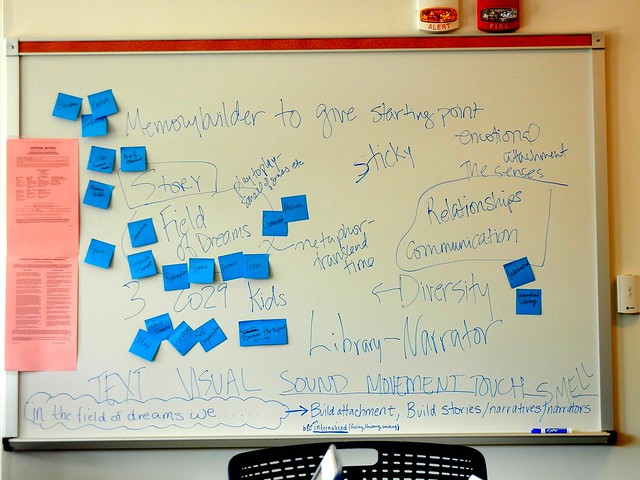
Idea board, Cohort D
Image: Idea Board, Cohort D by dianecordell


ReImagine: Ed was a gathering of approximately 200 librarians, technology directors, and designers at The Lovett School in Atlanta and was focused on using the design process to  imagine the school library of the future.
This conference seemed to be more focused on the physical library as a learning space, and less about the teaching that happens in that space. I learned that we as a profession are well on our way to knowing where we want to go, but the harder next step is how to get there. For some issues, like seamless integration of ebooks, we need to muddle through this time of innovation and uncertainty in the ebook market. But when we think of the library as a space for curiosity and innovation, we need to start now by introducing the ideas to our communities. Like last year, I am focused on Mimi Ito’s work with the MacArthur Foundation and the YOUMedia lab in Chicago as a model we should try to develop for our school.

ReImagine Ed had some very talented leaders and “provocateurs,” and one of my favorites was Lee Van Ordsel, the Dean of University Libraries at Grand Valley State University in Allendale, Michigan. She walked us through her inspiration and vision behind her university’s new main library, which is to be completed by May of 2013.  I enjoyed how she spoke about the different uses of space, and her metaphor of the library as a shopping mall was compelling.  In a shopping mall, everything is in one social space. “Nobody likes an empty mall,” Ms. Van Ordsel pointed out, so in her library the consumers get to choose what they do, they control the experience, but they also allow for serendipity.
The new library will almost all be for group study, (although there will be some nooks for individual study too) where students can essentially create a room wherever they want to. The space is flexible, blending intellectual and social. They will also provide knowledge market kiosks, no appointments necessary, including a writing center, speech center, I.T. help desk, and research center, all run by student peers.
I enjoyed hearing about this vision and extracting how it might work at my school. My students still need a quiet zone - our many study carrels are very popular, but the other ideas could be redesigned for a small independent school like mine.

After listening to Buffy Hamilton speak powerfully about Enchantment and Bud Hunt talk passionately about the importance of school libraries as a safe space (virtual and physical),  I came away with ideas on how to make the library a meaningful place in the lives of our students by being a place where students are safe to be themselves, safe to try and fail, and safe to be creative and make connections. I enjoyed brainstorming library metaphors and learning how libraries can fit into different models.

All in all, ReImagine Ed was a unique, enjoyable, and difficult conference. Grouping professionals with different backgrounds and different ideas of libraries together to work collaboratively had its ups and downs, as did some of the structure of the conference. But it was a good and challenging experience, and I learned a lot about the design process, libraries, librarians, and myself. For more of what my group ended up with, see Diane Cordell's blogpost about Cohort D.


Stay tuned for Part Two: AASL